
Not every kitchen lead is ready for design.
Some are serious buyers with a real project, a clear timeline, and the right information to move forward. Others are still browsing, collecting ideas, or pricing out possibilities without being ready to commit. The challenge for kitchen showrooms is that both types often enter the pipeline the same way.
That is where teams start losing time.
A designer opens a file, starts working on a layout, and only later finds out the customer does not have a real budget, has not measured the space, or is nowhere near making a decision. Multiply that across a few leads a week, and design capacity starts getting eaten up by work that is not moving toward a quote or a close.
That is why kitchen lead qualification matters.
A simple kitchen lead qualification scorecard helps showrooms separate high-potential opportunities from early-stage inquiries before design begins. It gives sales teams a more consistent way to assess lead quality, prioritize the right work, and protect design time for the leads most likely to move forward.
What is a qualified kitchen lead?
A qualified kitchen lead is not just someone who fills out a form or asks for a design. It is a lead that has enough intent, information, and readiness to justify the next step in your sales process.
That does not mean every qualified kitchen lead needs to be ready to sign immediately. It means they have the core ingredients that make design work productive instead of premature.
In most kitchen showrooms, qualified kitchen leads share a few common traits. They have a defined project scope, a rough budget range, a realistic timeline, and some level of decision-making authority. They are also far more likely to provide the details needed to start design properly, such as measurements, inspiration, or project goals.
Lead scoring for kitchen showrooms helps turn this into something measurable. Instead of relying on gut feel alone, your team can use a repeatable framework to determine which leads are ready for design now, which need more nurturing, and which should stay in an earlier stage until they are more prepared.
When qualification is done well, the payoff is not just better leads; It’s better use of design time, faster quoting, and fewer projects stalling halfway through the process.
What questions should your intake collect before design starts?
If you want better qualified kitchen leads, the intake process needs to do more than capture a name and phone number.
The goal of intake is to collect enough information to understand whether the project is real, whether the customer is ready, and whether the lead should move into design yet. The more complete the intake, the easier it is to prioritize the right leads and avoid unnecessary revision cycles later.
At a minimum, your intake should collect:
- Project scope: Is this a full kitchen remodel, a cabinet refresh, a new build, or another space like a mudroom, bathroom, or closet?
- Budget range: Has the customer shared a realistic investment range, even broadly?
- Timeline: Are they hoping to start next month, later this year, or are they just exploring options?
- Decision-maker status: Is the person reaching out the primary decision-maker, or are other stakeholders involved?
- Measurement readiness: Do they have measurements, plans, photos, or anything that makes design work more accurate?
- Project motivation: Why are they reaching out now? Are they renovating soon, gathering quotes, replacing damaged cabinetry, or just collecting ideas?
- Product fit: Are they aligned with the types of cabinetry, service level, and price point your showroom actually offers?
These questions do two things at once. First, they help your team qualify kitchen showroom leads more consistently. Second, they improve the quality of the handoff into design when a lead is ready.
Good intake is not about adding friction for the customer. It is about creating clarity early, so your team can put the right level of effort in the right place.
What should a kitchen lead qualification scorecard include?
A good lead scorecard should be simple enough for the team to use consistently and clear enough to guide next steps. You do not need a complex CRM model to make lead scoring for kitchen showrooms useful. A five-part system is often enough.
Here is one practical framework.
Budget: 0 to 5 points
Budget is one of the clearest signs of readiness. A lead does not need to give an exact number, but there should be some sense of what they are prepared to invest.
- 0 points: Refuses to discuss budget or clearly expects pricing far below your market
- 1 to 2 points: Very rough budget, unclear fit, or unrealistic expectations
- 3 to 4 points: Budget range shared and likely aligned
- 5 points: Clear budget and strong fit with your offering
Timeline: 0 to 5 points
Timeline helps separate active buyers from early researchers.
- 0 points: No timeline, “just curious,” or project is far off
- 1 to 2 points: General interest, but no defined start window
- 3 to 4 points: Planning to move within a reasonable timeframe
- 5 points: Active project with a clear next-step timeline
Scope clarity: 0 to 5 points
A lead should be able to explain what kind of project they have, even if details are still evolving.
- 0 points: Scope is vague or constantly shifting
- 1 to 2 points: General idea, but major details are missing
- 3 to 4 points: Project type and needs are mostly clear
- 5 points: Strong scope clarity with specific goals or constraints
Decision-maker status: 0 to 5 points
You do not want to move too far into design with someone who cannot actually move the project forward.
- 0 points: Not a decision-maker and no visibility into who is
- 1 to 2 points: One of several stakeholders, but unclear process
- 3 to 4 points: Has strong influence or direct involvement in the decision
- 5 points: Primary decision-maker is engaged
Measurement readiness: 0 to 5 points
Design moves better when the customer is prepared.
- 0 points: No measurements, photos, or plans
- 1 to 2 points: Some information, but not enough to support clean handoff
- 3 to 4 points: Measurements or supporting details are mostly ready
- 5 points: Accurate measurements, photos, or plans are ready to go
That gives you a score out of 25.
A simple way to use it:
- 20 to 25: High-priority qualified kitchen lead, ready for design
- 14 to 19: Promising lead, but may need a few gaps filled first
- 0 to 13: Early-stage lead that should be nurtured before design begins
The exact ranges can shift based on your showroom, but the point is consistency. A scorecard helps your team stop treating every lead the same.
What should you do with low-score leads without losing them?
A low score does not mean a bad lead. It usually means “not ready yet.”
That distinction matters. If your team treats every low-score lead like a dead end, you risk losing future business. But if you send every low-score lead straight into design, you waste time and clog up the pipeline.
The better approach is to match the next step to the lead’s readiness.
If the lead is missing budget clarity, your team may need to have a more direct conversation about investment ranges before design starts. If the issue is measurements, the next step may be asking for photos, dimensions, or booking a measurement service. If the customer is early in the process, they may need educational content, product guidance, or a follow-up sequence instead of a design package.
This is where a good showroom process really helps. High-score leads move into design. Mid-score leads get guided toward readiness. Low-score leads stay warm without consuming too much design capacity.
That approach protects your team’s time while still giving the customer a good experience.
It also helps reduce one of the most common causes of design backlog: doing too much work too early for leads that have not earned that level of effort yet.
Should you discuss budget on the first call?
Yes, in most cases you should.
That does not mean forcing an awkward number out of the customer immediately. It means getting enough information to understand whether the project aligns with your showroom and whether design makes sense as the next step.
Budget is one of the clearest indicators of kitchen lead qualification. Without it, teams can spend a lot of time designing for leads that were never a fit. A simple, low-pressure question about investment range is usually enough to start the conversation.
What if competitors offer free designs?
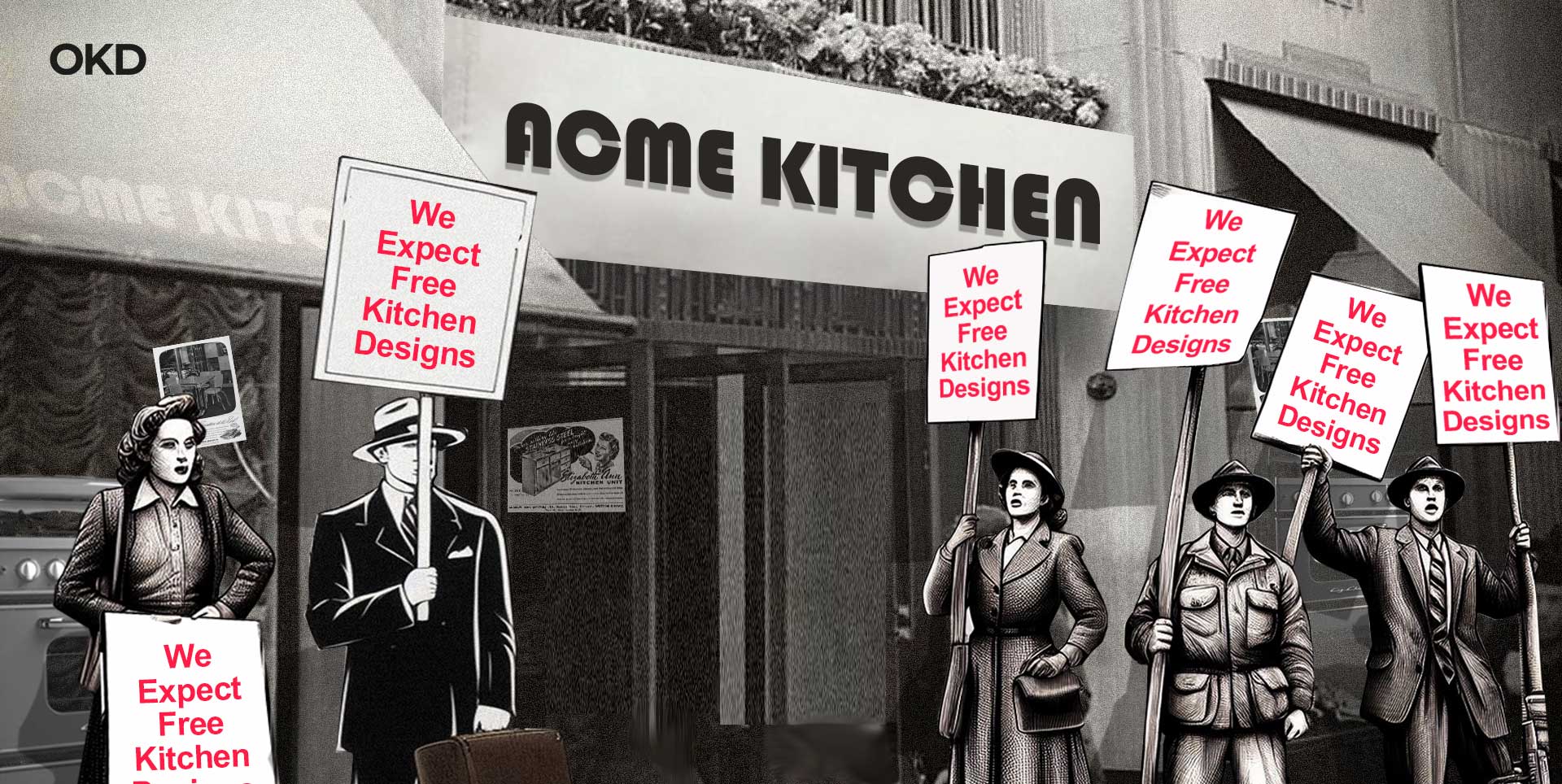
Free designs can make qualification harder, but they do not change the need for it.
If competitors are using free design as a lead magnet, your showroom still needs a way to decide who gets design time and when. Otherwise, your internal team can end up overloaded with low-intent leads. A strong qualification process helps you protect design capacity while still giving serious leads a smooth path forward.
How do you qualify online leads?
Online leads should be qualified through the same core criteria: budget, timeline, scope, decision-maker status, and measurement readiness.
The difference is how you collect the information. Online forms, estimator tools, intake questionnaires, and follow-up calls can all help gather the details needed to score the lead. The goal is the same whether the lead comes in by phone, referral, or website: understand readiness before design begins.
Contact OKD to learn more
If your team is spending too much design time on leads that are not ready to move forward, OKD can help. Contact OKD to learn how better intake, stronger qualification, and outsourced kitchen design support can help you protect design capacity and keep the right opportunities moving.
Business tips from the OKD team
Business tips from
the OKD team


For a lot of kitchen showrooms, cabinet dealers, and online sellers, quoting is where momentum starts to break down.
For a lot of kitchen showrooms, cabinet dealers, and online sellers, quoting is where momentum starts to break down.
For a lot of kitchen showrooms, cabinet dealers, and online sellers, quoting is where momentum
Read More …

A lot of kitchen and cabinet businesses hit the same point as they grow: sales stay busy, but designs
A lot of kitchen and cabinet businesses hit the same point as they grow: sales stay busy, but designs
A lot of kitchen and cabinet businesses hit the same point as they grow: sales
Read More …
A lot of kitchen and cabinet companies lose momentum between the first customer conversation and the point where the
A lot of kitchen and cabinet companies lose momentum between the first customer conversation and the point where the
A lot of kitchen and cabinet companies lose momentum between the first customer conversation and
Read More …

Revision loops are one of the easiest ways for kitchen showrooms, cabinet dealers, and design teams to lose margin
Revision loops are one of the easiest ways for kitchen showrooms, cabinet dealers, and design teams to lose margin
Revision loops are one of the easiest ways for kitchen showrooms, cabinet dealers, and design
Read More …

Backlogs do not usually start with one big problem. They build quietly. A few more leads come in than
Backlogs do not usually start with one big problem. They build quietly. A few more leads come in than
Backlogs do not usually start with one big problem. They build quietly. A few more
Read More …

Selling cabinets online sounds efficient on paper. More leads. Faster quoting. Fewer in-showroom meetings. Wider reach. But for many
Selling cabinets online sounds efficient on paper. More leads. Faster quoting. Fewer in-showroom meetings. Wider reach. But for many
Selling cabinets online sounds efficient on paper. More leads. Faster quoting. Fewer in-showroom meetings. Wider
Read More …

A lot of revision loops start before design even begins. Usually, it is not because the designer got it
A lot of revision loops start before design even begins. Usually, it is not because the designer got it
A lot of revision loops start before design even begins. Usually, it is not because
Read More …

Cabinet Genies boosts showroom sales with OKD design support Showrooms feeling stuck in the balance between sales and design
Cabinet Genies boosts showroom sales with OKD design support Showrooms feeling stuck in the balance between sales and design
Cabinet Genies boosts showroom sales with OKD design support Showrooms feeling stuck in the balance
Read More …

For any kitchen cabinet distributor needing to grow their business more efficiently, the solution is literally at your fingertips:
For any kitchen cabinet distributor needing to grow their business more efficiently, the solution is literally at your fingertips:
For any kitchen cabinet distributor needing to grow their business more efficiently, the solution is
Read More …

Not every kitchen lead is ready for design. Some are serious buyers with a real project, a clear timeline, and
Not every kitchen lead is ready for design. Some are serious buyers with a real project, a clear timeline, and
Not every kitchen lead is ready for design. Some are serious buyers with a real project,
Read More …

A kitchen showroom can seem like its leads are flowing, when in reality, there are roadblocks that keep it falling
A kitchen showroom can seem like its leads are flowing, when in reality, there are roadblocks that keep it falling
A kitchen showroom can seem like its leads are flowing, when in reality, there are roadblocks
Read More …
A concept design is one of the most useful tools a kitchen sales team can have when used the
A concept design is one of the most useful tools a kitchen sales team can have when used the
A concept design is one of the most useful tools a kitchen sales team can
Read More …

A lot can go wrong when the first kitchen consultation is too loose. Let’s say that someone calls in
A lot can go wrong when the first kitchen consultation is too loose. Let’s say that someone calls in
A lot can go wrong when the first kitchen consultation is too loose. Let’s say
Read More …

OKD’s plug-and-play system will get you kitchen sales you never considered. What do we mean by “Plug-and-Play”? In the tech
OKD’s plug-and-play system will get you kitchen sales you never considered. What do we mean by “Plug-and-Play”? In the tech
OKD’s plug-and-play system will get you kitchen sales you never considered. What do we mean by
Read More …

There’s an important shift happening in successful kitchen showroom designers and owners that are helping them scale; The traditional
There’s an important shift happening in successful kitchen showroom designers and owners that are helping them scale; The traditional
There’s an important shift happening in successful kitchen showroom designers and owners that are helping
Read More …
A customer is ready to move forward. The first conversation went well, the project looks promising, and the sales
A customer is ready to move forward. The first conversation went well, the project looks promising, and the sales
A customer is ready to move forward. The first conversation went well, the project looks
Read More …
Increasing each customer’s contract amount (when mutually beneficial) can make or break a kitchen showroom.Showrooms that make it sell cabinets
Increasing each customer’s contract amount (when mutually beneficial) can make or break a kitchen showroom.Showrooms that make it sell cabinets
Increasing each customer’s contract amount (when mutually beneficial) can make or break a kitchen showroom.Showrooms that
Read More …
Have you ever dealt with ‘kitchen design/quote fatigue’? If you think the answer is no, but you feel exhausted
Have you ever dealt with ‘kitchen design/quote fatigue’? If you think the answer is no, but you feel exhausted
Have you ever dealt with ‘kitchen design/quote fatigue’? If you think the answer is no,
Read More …

The kitchen business is full of showrooms eager to give away kitchen designs to pretty much anyone. It doesn’t
The kitchen business is full of showrooms eager to give away kitchen designs to pretty much anyone. It doesn’t
The kitchen business is full of showrooms eager to give away kitchen designs to pretty
Read More …
Today, I want to demonstrate how to free your kitchen showroom salespeople. Freeing them to do what comes naturally: sell
Today, I want to demonstrate how to free your kitchen showroom salespeople. Freeing them to do what comes naturally: sell
Today, I want to demonstrate how to free your kitchen showroom salespeople. Freeing them to do
Read More …
When dealing with potential kitchen customers, you’re not just selling cabinets – you're listening for the future. Listen closely
When dealing with potential kitchen customers, you’re not just selling cabinets – you're listening for the future. Listen closely
When dealing with potential kitchen customers, you’re not just selling cabinets – you're listening for
Read More …

It’s about getting more quotes to more potential customers In this article: Simple steps to boost kitchen showroom sales growth
It’s about getting more quotes to more potential customers In this article: Simple steps to boost kitchen showroom sales growth
It’s about getting more quotes to more potential customers In this article: Simple steps to boost
Read More …
For a lot of kitchen showrooms, cabinet dealers, and online sellers, quoting is where momentum starts to break down.
For a lot of kitchen showrooms, cabinet dealers, and online sellers, quoting is where momentum starts to break down.
For a lot of kitchen showrooms, cabinet dealers, and online sellers, quoting is where momentum
Read More …
A lot of kitchen and cabinet businesses hit the same point as they grow: sales stay busy, but designs
A lot of kitchen and cabinet businesses hit the same point as they grow: sales stay busy, but designs
A lot of kitchen and cabinet businesses hit the same point as they grow: sales
Read More …
A lot of kitchen and cabinet companies lose momentum between the first customer conversation and the point where the
A lot of kitchen and cabinet companies lose momentum between the first customer conversation and the point where the
A lot of kitchen and cabinet companies lose momentum between the first customer conversation and
Read More …
Revision loops are one of the easiest ways for kitchen showrooms, cabinet dealers, and design teams to lose margin
Revision loops are one of the easiest ways for kitchen showrooms, cabinet dealers, and design teams to lose margin
Revision loops are one of the easiest ways for kitchen showrooms, cabinet dealers, and design
Read More …
Backlogs do not usually start with one big problem. They build quietly. A few more leads come in than
Backlogs do not usually start with one big problem. They build quietly. A few more leads come in than
Backlogs do not usually start with one big problem. They build quietly. A few more
Read More …
Selling cabinets online sounds efficient on paper. More leads. Faster quoting. Fewer in-showroom meetings. Wider reach. But for many
Selling cabinets online sounds efficient on paper. More leads. Faster quoting. Fewer in-showroom meetings. Wider reach. But for many
Selling cabinets online sounds efficient on paper. More leads. Faster quoting. Fewer in-showroom meetings. Wider
Read More …
A lot of revision loops start before design even begins. Usually, it is not because the designer got it
A lot of revision loops start before design even begins. Usually, it is not because the designer got it
A lot of revision loops start before design even begins. Usually, it is not because
Read More …
Cabinet Genies boosts showroom sales with OKD design support Showrooms feeling stuck in the balance between sales and design
Cabinet Genies boosts showroom sales with OKD design support Showrooms feeling stuck in the balance between sales and design
Cabinet Genies boosts showroom sales with OKD design support Showrooms feeling stuck in the balance
Read More …
For any kitchen cabinet distributor needing to grow their business more efficiently, the solution is literally at your fingertips:
For any kitchen cabinet distributor needing to grow their business more efficiently, the solution is literally at your fingertips:
For any kitchen cabinet distributor needing to grow their business more efficiently, the solution is
Read More …
Not every kitchen lead is ready for design. Some are serious buyers with a real project, a clear timeline, and
Not every kitchen lead is ready for design. Some are serious buyers with a real project, a clear timeline, and
Not every kitchen lead is ready for design. Some are serious buyers with a real project,
Read More …
A kitchen showroom can seem like its leads are flowing, when in reality, there are roadblocks that keep it falling
A kitchen showroom can seem like its leads are flowing, when in reality, there are roadblocks that keep it falling
A kitchen showroom can seem like its leads are flowing, when in reality, there are roadblocks
Read More …
A concept design is one of the most useful tools a kitchen sales team can have when used the
A concept design is one of the most useful tools a kitchen sales team can have when used the
A concept design is one of the most useful tools a kitchen sales team can
Read More …
A lot can go wrong when the first kitchen consultation is too loose. Let’s say that someone calls in
A lot can go wrong when the first kitchen consultation is too loose. Let’s say that someone calls in
A lot can go wrong when the first kitchen consultation is too loose. Let’s say
Read More …
OKD’s plug-and-play system will get you kitchen sales you never considered. What do we mean by “Plug-and-Play”? In the tech
OKD’s plug-and-play system will get you kitchen sales you never considered. What do we mean by “Plug-and-Play”? In the tech
OKD’s plug-and-play system will get you kitchen sales you never considered. What do we mean by
Read More …
There’s an important shift happening in successful kitchen showroom designers and owners that are helping them scale; The traditional
There’s an important shift happening in successful kitchen showroom designers and owners that are helping them scale; The traditional
There’s an important shift happening in successful kitchen showroom designers and owners that are helping
Read More …
A customer is ready to move forward. The first conversation went well, the project looks promising, and the sales
A customer is ready to move forward. The first conversation went well, the project looks promising, and the sales
A customer is ready to move forward. The first conversation went well, the project looks
Read More …
Increasing each customer’s contract amount (when mutually beneficial) can make or break a kitchen showroom.Showrooms that make it sell cabinets
Increasing each customer’s contract amount (when mutually beneficial) can make or break a kitchen showroom.Showrooms that make it sell cabinets
Increasing each customer’s contract amount (when mutually beneficial) can make or break a kitchen showroom.Showrooms that
Read More …
Have you ever dealt with ‘kitchen design/quote fatigue’? If you think the answer is no, but you feel exhausted
Have you ever dealt with ‘kitchen design/quote fatigue’? If you think the answer is no, but you feel exhausted
Have you ever dealt with ‘kitchen design/quote fatigue’? If you think the answer is no,
Read More …
The kitchen business is full of showrooms eager to give away kitchen designs to pretty much anyone. It doesn’t
The kitchen business is full of showrooms eager to give away kitchen designs to pretty much anyone. It doesn’t
The kitchen business is full of showrooms eager to give away kitchen designs to pretty
Read More …
Today, I want to demonstrate how to free your kitchen showroom salespeople. Freeing them to do what comes naturally: sell
Today, I want to demonstrate how to free your kitchen showroom salespeople. Freeing them to do what comes naturally: sell
Today, I want to demonstrate how to free your kitchen showroom salespeople. Freeing them to do
Read More …
When dealing with potential kitchen customers, you’re not just selling cabinets – you're listening for the future. Listen closely
When dealing with potential kitchen customers, you’re not just selling cabinets – you're listening for the future. Listen closely
When dealing with potential kitchen customers, you’re not just selling cabinets – you're listening for
Read More …
It’s about getting more quotes to more potential customers In this article: Simple steps to boost kitchen showroom sales growth
It’s about getting more quotes to more potential customers In this article: Simple steps to boost kitchen showroom sales growth
It’s about getting more quotes to more potential customers In this article: Simple steps to boost
Read More …